
How Much Bac Water For 30Mg Retatrutide: Accurate Dilution Guide
Last Updated on October 5, 2026
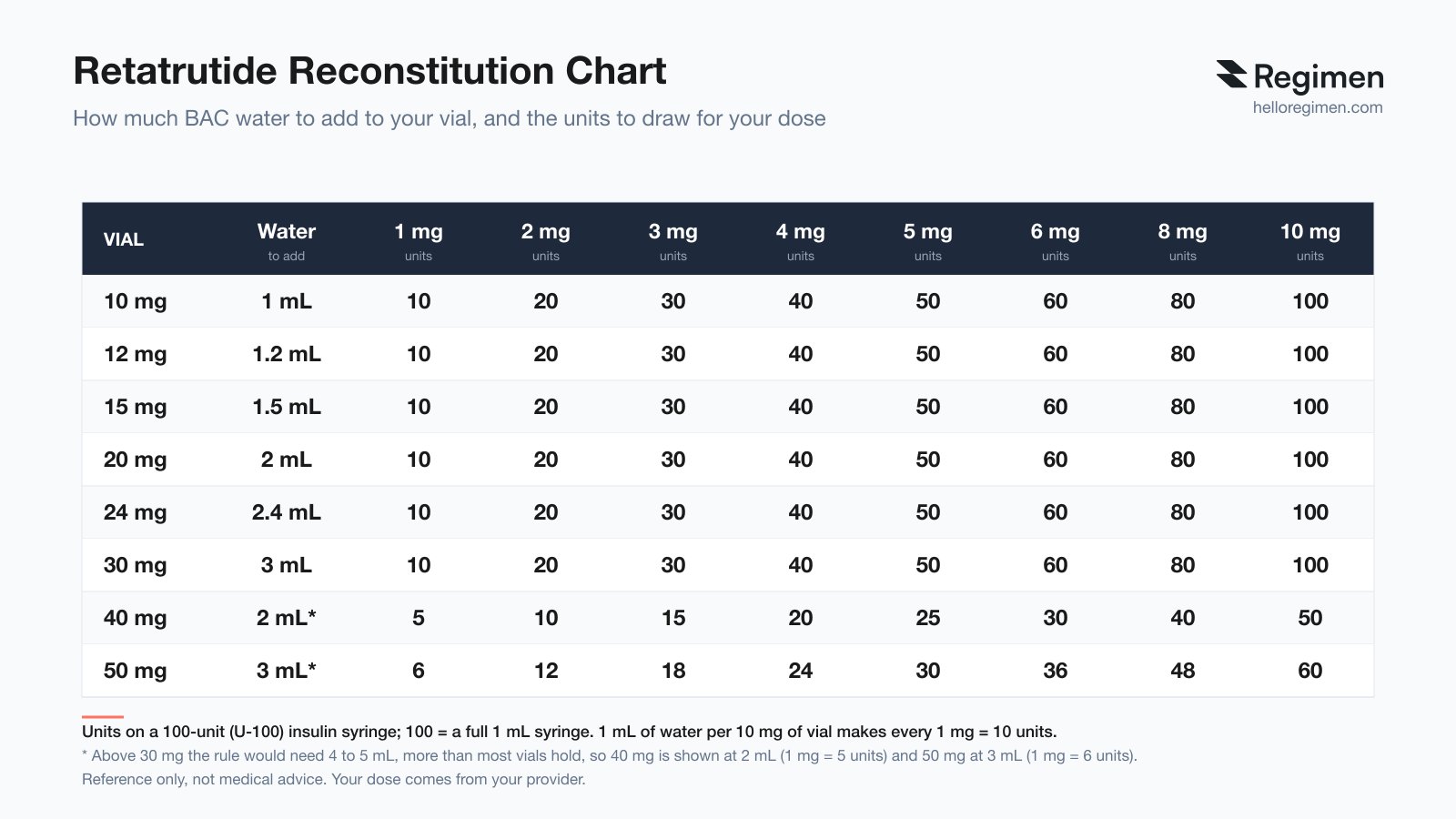
To determine the amount of bacteriostatic water needed, use a How Much Bac Water For 30Mg Retatrutide Calculator to decide on your preferred concentration, such as 1 milliliter per 10 milligrams, which would require 3 milliliters of bacteriostatic water to dilute a 30-milligram vial for precise dosing.
Mixing and Preparation
The most important factor is maintaining sterility throughout the entire process to prevent contamination of the solution. Using non-sterile tools or touching the needle tip is the most common mistake, which can lead to bacterial growth inside the vial. Always sanitize the rubber stopper with an alcohol wipe before you insert any needle.
Calculating water for your retatrutide dose
- Clean the rubber stopper of your 30mg retatrutide vial and the top of your bacteriostatic water bottle with a new 70% isopropyl alcohol pad.
- Draw your chosen volume of bacteriostatic water into a sterile syringe, ensuring you have the exact amount for your target concentration.
- Insert the needle into the vial at a slight angle to avoid hitting the center of the stopper, which helps prevent coring the rubber.
- Inject the liquid slowly down the side of the glass wall rather than directly onto the powder, allowing the water to pool at the bottom.
- Remove the needle and gently swirl the vial between your palms until the powder fully dissolves into a clear liquid without any visible particles.
- Store the mixed solution in a refrigerator to maintain stability, as improper storage can lead to protein degradation according to the United States Pharmacopeia guidelines on sterile preparations.
Tip:
Tip: If you see cloudy residue after swirling, let the vial sit undisturbed in the refrigerator for 15 minutes before checking it again.
Estimating Mixing Time
The total time needed depends on your comfort level with sterile techniques and the volume of liquid being handled. This assumes you’re using a standard 3ml or 5ml syringe; if you’re using a smaller insulin-style syringe, allow extra time for the slower draw speed.
| Situation | How long | What changes it | What to watch for |
|---|---|---|---|
| Single vial mix | 3-5 minutes | Experience level | Air bubbles |
| Batch preparation | 10-15 minutes | Number of vials | Seal integrity |
| Cold water usage | 20-30 minutes | Temperature | Solubility rate |
Visual Confirmation of Completion
You know the solution is ready when the liquid is completely clear and free of any floating white clumps or sediment. Hold the vial against a bright light source to inspect for tiny particles that might remain suspended in the fluid. If you see any cloudiness or discoloration, the preparation isn’t safe to use. If the signs remain unclear, the definitive test is visual clarity; a properly reconstituted peptide should look exactly like clear water. Never use a solution that shows signs of particulate matter or debris, as this indicates the powder hasn’t fully integrated.
Common Errors During Preparation
- Contaminating the needle: Touching the sterile needle tip to any surface introduces bacteria into your solution, potentially causing an infection. Always keep the cap on until the exact second you’re ready to pierce the stopper.
- Forcing the water: Injecting the liquid too quickly can cause pressure buildup or damage the peptide, so always press the plunger with steady, controlled pressure.
- Using non-sterile water: Using tap or distilled water instead of bacteriostatic water leaves the solution without a preservative, leading to rapid bacterial contamination. Always ensure your water is labeled specifically as bacteriostatic, which usually contains 0.9% benzyl alcohol as a preservative.
- Inconsistent storage: Leaving the vial out at room temperature for too long can reduce the shelf life of the peptide, so move it to the refrigerator immediately after mixing.
Can I use sterile water instead of bacteriostatic water?
No, you shouldn’t use sterile water because it lacks the benzyl alcohol preservative found in bacteriostatic water. Without this preservative, bacteria can multiply quickly in the solution, making it unsafe for use after the initial puncture. Always verify the label on your water supply before you begin.
Is it safe to store the vial in the freezer?
No, freezing is generally not recommended for reconstituted peptides because the expansion of water during freezing can damage the structure of the medicine. Keep the vial in the refrigerator at a temperature between 36 and 46 degrees Fahrenheit to ensure the best results and maintain the product’s integrity.
How much water should I use for a 30mg vial?
You can use any volume that makes your math easy, but 3 milliliters is a common choice for a 30mg vial. This creates a concentration of 1 milligram per 0.1 milliliters of fluid, which simplifies your dosing calculations. Always double-check your math before you draw the water.
What happens if I use too much water?
Nothing bad happens to the medicine itself, but it makes the volume per dose larger than you might want. If you add 6 milliliters to a 30mg vial, your concentration becomes 0.5 milligrams per 0.1 milliliters. You’ll simply need to inject twice the volume to get the same amount of medicine.
Why is my vial cloudy after mixing?
Cloudiness usually happens if you didn’t let the vial sit long enough or if the powder wasn’t high quality. If it remains cloudy or has chunks, don’t use it, as it may be contaminated.
How long does a 30mg vial last once mixed?
A 30mg vial typically lasts for 28 days if you keep it refrigerated and follow proper sterile handling. Check the manufacturer’s instructions for the specific brand you’re using, as some might have shorter stability windows. If the liquid changes color or grows particles, discard it immediately.
What should I do if I puncture the stopper too many times?
If you notice the rubber stopper is damaged or starts to crumble from too many needle punctures, the seal is no longer sterile. Stop using that vial immediately to prevent air and contaminants from entering. Always use a fresh needle for every draw to keep the rubber stopper in good condition.
Bac Water, in short
Always store your prepared vial in the refrigerator to keep the solution stable and effective. Since you’ve finished the mixing process, you’re ready to organize your schedule and track your progress carefully. Don’t forget to use a fresh, sterile syringe for every injection to ensure you’re staying safe and healthy.
Related guides